
Companies have invested billions in helping people find the right products and content. The next opportunity may be helping people interact with information more effectively.
Organizations have spent decades optimizing how people find products, discover content, and complete transactions. Recommendation engines guide purchases. Search algorithms surface relevant information. User experience teams streamline workflows and eliminate unnecessary clicks.
Yet one of the most important sources of friction in digital experiences remains largely overlooked: the act of reading itself.
Every day, people read product information before making purchases, employee training before performing tasks, patient instructions before following treatment plans, government communications before accessing services, and the list goes on.
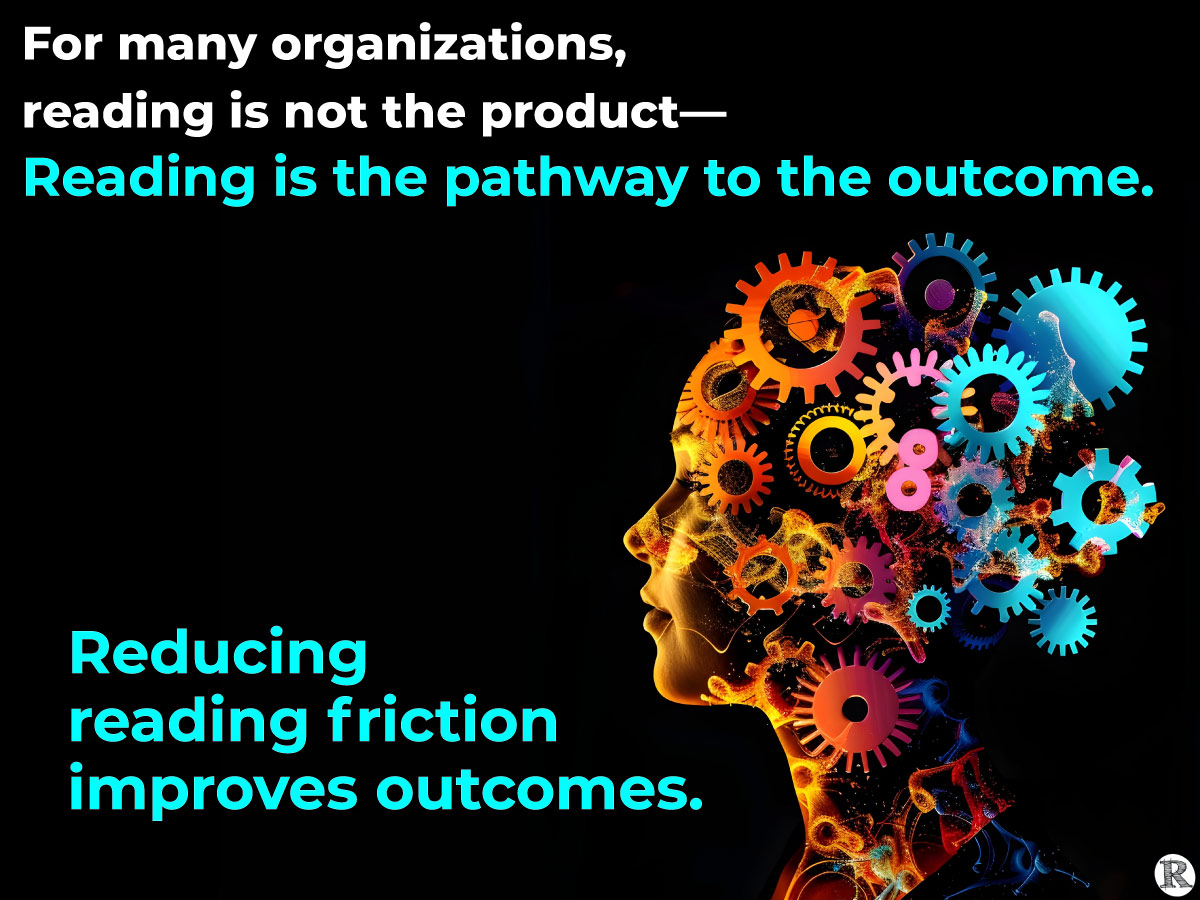
For most organizations, reading is not the outcome. Reading is the pathway to the outcome.
And when that pathway becomes difficult, slow, or frustrating, business results suffer.
The Hidden Cost of Reading Friction
Executives understand the cost of friction. Companies invest heavily in removing obstacles that prevent customers, employees, or users from achieving desired outcomes.
In e-commerce, friction occurs when customers struggle to find products. In streaming media, it occurs when viewers cannot find something worth watching. In software, it appears when users abandon complicated workflows.
Reading friction is different but no less important.
It may appear as visual discomfort, greater cognitive effort, slower information processing, reduced comprehension, fatigue, or task abandonment. Organizations rarely observe the friction directly. Instead, they experience its consequences: lower completion rates, higher support costs, weaker engagement, missed opportunities, and poorer outcomes.
Most digital systems still present essentially the same reading experience to every user—even though they personalize almost every other aspect of the digital experience.
Why One Reading Experience Doesn’t Fit Everyone
Readers differ significantly in how they interact with text. Typography, spacing, line length, contrast, device type, reading goals, and individual preferences all influence reading comfort and performance.
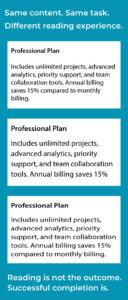 A presentation that feels effortless for one reader may feel inefficient or exhausting for another.
Research across reading science, human-computer interaction, accessibility, and cognitive psychology increasingly suggests that presentation affects reading speed, comprehension, engagement, and persistence. No single format is universally optimal; different readers often perform better under different conditions.
Rather than searching for one best reading experience, organizations may achieve better results by enabling better reading experiences for different individuals.
The Next Stage of Personalization
Digital personalization has evolved in stages.
First, organizations personalized products. Then they personalized content. More recently, they personalized interfaces and workflows.
The next stage may be personalizing how people interact with information itself.
Companies such as Amazon, Netflix, Spotify, and YouTube created enormous value by reducing the effort required to discover relevant products and content. Reading remains one of the largest interactions in digital environments, yet it has received comparatively little personalization.
Most systems adapt what users see. Very few adapt how users read it.
Why This Matters Now
If personalized reading environments improve performance even modestly, the implications could be substantial.
Consider a healthcare provider whose patients better understand treatment instructions. An online learning platform whose learners complete more courses. A government agency whose citizens successfully complete more forms. A software company whose customers understand onboarding materials more quickly. An employer whose workforce absorbs training content more efficiently.
In each case, the content remains unchanged.
The difference lies in how effectively users interact with that content.
Small gains become meaningful when multiplied across thousands, millions, or even billions of interactions. Organizations routinely invest heavily to improve conversion rates by fractions of a percent. Comparable gains in comprehension, completion, adherence, learning, or productivity could create value at a similar scale.
The business question is not whether reading matters.
The business question is whether organizations are fully optimizing one of the most important activities their users perform.
If the Opportunity Is Real, Why Hasn’t It Happened Already?
Several factors have slowed adoption.
Historically, print-based thinking shaped digital reading experiences. Text presentation was largely fixed, making large-scale personalization difficult or impossible.
Organizations also lacked practical mechanisms for understanding how different presentation formats affected different users.
Today, those constraints are changing.
Digital platforms can dynamically adjust presentation. Advances in analytics make it easier to measure user behavior and outcomes. Artificial intelligence increasingly enables adaptive interfaces that respond to individual needs and preferences. (See: Generative UI Meets Better Readability: Beyond AI-Assisted Design, Using AI to Generate Custom Interfaces for Each User in Real Time.)
In their Harvard Business Review article, Personalization Done Right, Abraham and Edelman observe that AI changes the economics of personalization. Machine learning and generative AI make it possible to personalize millions of interactions simultaneously, continuously test different approaches, and refine experiences based on customer behavior.
A Practical Starting Point
Organizations do not need artificial intelligence or sophisticated prediction models to begin.
The simplest approach is offering meaningful choice.
Options such as text size, typography, spacing, contrast, line length, and presentation preferences allow users to tailor reading environments to their own needs while giving organizations insight into which adjustments correlate with better outcomes.
This mirrors how personalization evolved elsewhere. Companies did not begin by perfectly predicting customer preferences. They began by offering choices, observing behavior, and learning from data.
Reading personalization may evolve in much the same way.
From Accessibility Initiative to Strategic Advantage
Many organizations currently view text customization primarily through the lens of accessibility and compliance. Those goals remain critically important.
But the opportunity may be much larger.
If reading influences learning, purchasing, productivity, adherence, decision-making, and task completion, then improving the reading experience has implications far beyond accessibility.
Organizations that measure and reduce reading friction may discover improvements in customer experience, employee performance, user engagement, and operational efficiency that traditional personalization efforts have overlooked.
The Next Personalization Frontier
For more than two decades, organizations have competed to personalize what people see.
The next frontier may be personalizing how people interact with what they see.
As digital experiences become increasingly adaptive, reducing reading friction may become one of the largest remaining opportunities for improving customer, employee, and citizen outcomes.
Organizations that begin measuring, testing, and optimizing the reading experience may uncover gains in engagement, completion, productivity, and customer success that have remained largely invisible—not because they were unimportant, but because reading itself has rarely been viewed as something that can be optimized.
The companies that helped users find the right products changed commerce. The companies that helped users find the right content transformed media.
The next generation of innovators can create value by reducing reading friction and thereby helping people understand, act on, and use information more effectively.
Generative UI Meets Better Readability: Beyond AI-Assisted Design